Tsinghua University Team Publishes Breakthrough CB[7] Supramolecular Nanopore Anion-Conducting Membrane in Nature
Developed cucurbit[7]uril-based supramolecular nanoporous anion-conducting membranes, overcoming the century-old trade-off among high conductivity, mechanical stability, and alkali resistance.
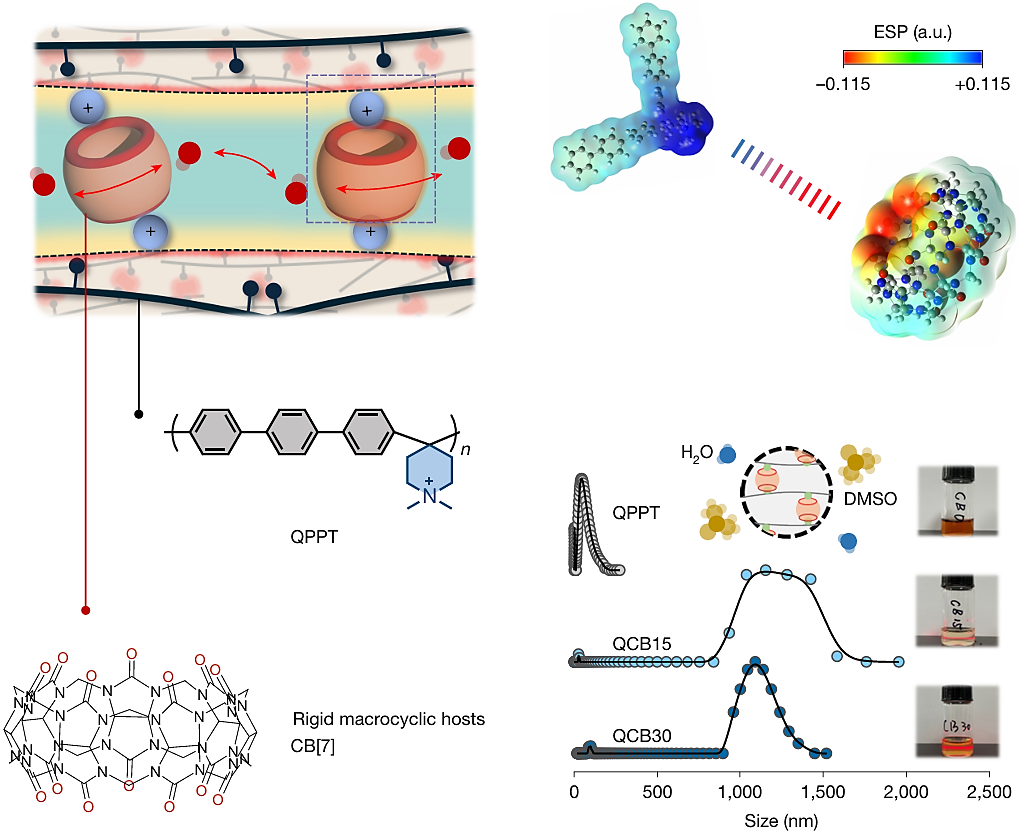
Professors Wang Baoguo and Associate Professor Liu Kai of Tsinghua University, along with their research team, have published groundbreaking findings in the academic journal Nature. The team developed supramolecular nanoporous anion-conducting membranes based on cucurbit[7]uril (CB[7]). This material overcomes a century-old bottleneck in traditional ion-exchange membranes: the inability to simultaneously achieve high ionic conductivity, robust mechanical stability, and strong alkali resistance. The innovation paves the way for new industrial applications in noble-metal-free alkaline water electrolysis, electrochemical CO2 reduction, and fuel cells.
Research subject: Cucurbit[7]uril (abbreviated as Q[7] or CB[7])
Highlight:
Moving beyond conventional approaches that modify polymer backbones or create pores through covalent frameworks, this work leverages cation-dipole host-guest interactions between macrocyclic cucurbit[7]uril (CB[7]) and quaternized polypiperidine terphenyl (QPPT) to self-assemble uniform, dynamic nanochannels. This strategy overcomes the inherent trade-off between mechanical strength and porosity in traditional microporous membranes and is universally applicable across a wide range of aromatic anion-conducting polymer backbones.
Cucurbituril-Based Anion-Conducting Membranes with Supramolecular Nanopores
Xu, Z.; Lin, D.; Yin, H.; Feng, Q.; Foglia, F.; Zhen, Y.; Morris, A.; Berrod, Q.; Pang, M.; Huang, L.; Liu, J.; Tian, J.; Wang, X.; Yang, C.; Tang, X.; Zhang, X.; Wang, B.; Wang, H.; Liu, K. Nature 2026, 654 (8120), 948–954. https://doi.org/10.1038/s41586-026-10666-6.
Authors: Xu, Z.; Lin, D.; Yin, H.; Feng, Q.; Foglia, F.; Zhen, Y.; Morris, A.; Berrod, Q.; Pang, M.; Huang, L.; Liu, J.; Tian, J.; Wang, X.; Yang, C.; Tang, X.; Zhang, X.; Wang, B.; Wang, H.; Liu, K.
Related Products
More research updates
- Huaqiao University & Xiamen Institute: CB[7] Supramolecular Confinement Strategy for Synergistic Fe Single-Atom and Cluster ORR ElectrocatalystAngewandte Chemie International Edition
- Syracuse University's Professor Xiaoran Hu: A cucurbit[7]uril–adamantane noncovalent click-to-release strategy enables a new pathway for supramolecular bioorthogonal activation.Angewandte Chemie International Edition
- Jilin University Team Publishes Breakthrough CB[8] Supramolecular Confinement Self-Sensitized Photooxidation in JACSJournal of the American Chemical Society (JACS)
Related background materials
- Cucurbituril structure and binding mechanismHow the rigid glycoluril skeleton, hydrophobic cavity, and carbonyl portals collectively govern affinity and selectivity.
- Cucurbiturils vs. Other Macrocyclic HostsDifferences in cavity size, affinity range, and portal groups compared to cyclodextrins, calixarenes, and pillararenes.
- Water-soluble modified cucurbituril seriesThree solubility strategies and the systems each is designed for.
- Custom synthesis serviceSubmit a request when replicating a special substitution pattern from a paper or scaling up.